
'China any day would prefer to team up with India and dump Pakistan once the resolution of the border dispute becomes an accomplished fact.'
.jpg)
We present Prime Minister Manmohan Singh's full speech as he addressed the country on the occasion of 66th Independence Day, from Red Fort, Delhi.

At present, in Myanmar, GAIL and IndianOil have a minority stake in a gas pipeline which goes to China, through South East Asia Gas Pipeline Company.

Here's how you can add a touch of tricolour to your celebrations.

BJP leader Ram Madhav's rant about Vice President Hamid Ansari's absence at the International Yoga Day celebrations goes deeper, says Syed Firdaus Ashraf, deep into their brain.
It is important for every sort of development and governance in Telangana that the people identify completely with their governing structures. This identification confers legitimacy on a government -- not just elections and number of votes. That identification has been missing in Telangana for 700 years, says Dr Gautam Pingle in the first of a two-part series on the new state.

'He needs to control his foot soldiers by taking either stern action against the over enthusiastic members of his group or convince them to stop causing him this embarrassment.' 'We know that most of these leaders are not going to be prosecuted by Indian authorities. So we are seeking alternate means to bring them to justice,' FIACONA President John Prabhudoss tells Aziz Haniffa/Rediff.com
'Karpoori Thakur must be remembered by people today who are tired of witnessing fractious politics where corruption, bigotry, hatred and violence seems to have become distressingly recurrent,' says Mohammad Sajjad.
'There is a problem with the rise of a popular view that sees Kashmir through the prism of the larger, chronic Hindu-Muslim tensions.' 'By redefining the Kashmir problem simplistically in Hindu-Muslim terms could end up keeping Kashmir but losing most Kashmiris,' says Shekhar Gupta.

'No civilised nation can thrive if it is possessed with the spirit of Hindutva.'
'Delhi was not concerned.' 'It would continue sleeping for several more years, with the result that Indian territory is still occupied by China today,' says Claude Arpi.

India and China on Friday agreed to seek a "political" solution to the border dispute at the earliest as Prime Minister Narendra Modi asked Beijing to "reconsider its approach on some issues" and announced CBMs like e-visa for Chinese tourists and operationalisation of hotline between two militaries.

The city readies itself for the biggest economic, political and social event of the year
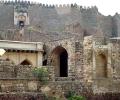
The Telangana government's decision to organise its first Independence Day celebrations at Golconda Fort instead of the Secunderabad Parade Grounds has sparked off a political controversy with opposition parties questioning the motive behind the move.

'If governments choose to spend our money on cow meat detection kits or hugely expensive statues, it is also a form of corruption.' 'A betrayal of our hopes and aspirations,' says Amit Mehra.
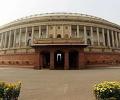
Congress vice president Rahul Gandhi has called a meeting of chief ministers of 12 Congress-ruled states to figure out how to fill out the vacancies in the Rajya Sabha. Highly-placed sources have said that he wants to cajole Amethis's former feudal lord Sanjay Singh; by giving him an RS ticket, in view of his own weak position in Amethi. Renu Mittal reports.

Rejecting the allegation of adopting "big brotherly" approach towards Nepal, India on said it respects its sovereignty and wants to see the crisis resolved through consensus.

The founder of the Republican Hindu Coalition first attracted attention in the US as the "Punjabi tycoon" who was a huge supporter of Narendra Modi in the US. 'He will be best for India. There is no better ally for the US than India in the region,' Shalabh Kumar tells Rediff.com's Vaihayasi Pande Daniel.

The President has approved award of 398 gallantry and other defence decorations to armed forces personnel and others on the eve of the 68th Republic Day Celebrations.
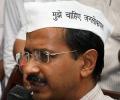
'The Congresswallahs will hope that Arvind Kejriwal's oratory and confidence will be the anti-aircraft guns to Narendra Modi's airwave-capturing force. Both Kejriwal and Modi speak Hindi well. Both are supremely self-confident about their agenda and vision. Some of their catch-phrases -- 'Vande Mataram' and 'Bharat Mata Ki Jai' -- are identical. Both are inspiring figures for their cadres. Both are not hesitant at all to wear their faith in Bhagwan on their foreheads on public platforms.' Sheela Bhatt believes that the 2014 election will be a Kejriwal versus Modi battle.

The absence of a clear underlying economic ideology in the Budget was quite evident, say experts.

If you want to wear your favourite designer or high-end label, simply rent it from fashion rental portals.

The government is following a path where it will not be irresponsible or profligate with public money but will intervene in the interest of the poor

The best message the Prime Minister could bring to London is that he will return to India to focus on economic matters. Britain, on its part, should ensure that it addresses matters that concern India, instead of engaging in pomp during his visit, says Adam Roberts.
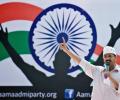
Social media teams of the Aam Aadmi Party, Bharatiya Janata Party and Congress are trying to engage with the voter on Facebook, twitter and Whatsapp as they try to set the agenda in the online space. Upasna Pandey/Rediff.com reports.
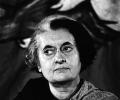
'According to me, her finest hour was in 1983-1984 when she neutralised a combined US-Pakistan-British conspiracy to Balkanise India by creating an independent Sikh State of Khalistan,' says Colonel Anil A Athale (retd). A special assessment of Indira Gandhi on her centenary.

'Somebody will need to blow the whistle, call the play to a halt, and convince all players that they belong on the same side of the goal,' says Shekhar Gupta.

The President talked about demonetisation, electoral reforms and disruptions in Parliament.

'The BJP had ruled earlier too, but nothing of this sort happened then... I don't say the government is behind the attacks, but they don't do anything to stop the attacks.' 'The prime minister has to tell the perpetrators that it is not in the interest of the government that such incidents happen.' 'When somebody says all Indians are Hindus, responsible people should ask him to stop and assure the country that this is not the opinion of the government. But it is not happening and it is quite unfortunate,' Cardinal Baselios Cleemis tells Shobha Warrier/Rediff.com in an exclusive interview.
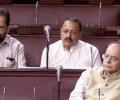
Most of the opposition parties blamed Rashtriya Swayamsevak Sangh-affiliates for the cow vigilantism.

'During his visit to Vietnam on September 3 -- the first visit by an Indian prime minister in 15 years -- Modi will notice the widespread anti-China sentiment in that country.'

A round-up of our favourite photographs from the week gone by.

The Opposition on Monday charged the government with trying to promote crony capitalism, creating fear by giving "unbridled power" to taxmen, trying to snoop into people's lives through increased use of Aadhaar through the provisions of the Finance Bill.

This is the lowest investment grade rating.

T P Sreenivasan was India's high commissioner in Fiji in 1987, when Sitiveni Rabuka toppled the Indian-dominated government there. Ambassador Sreenivasan stayed on for two years after the coup, fighting for the rights of the people of Indian origin before he was expelled by Rabuka. 'Meeting Sitiveni Rabuka, who had overthrown a democratically elected government, discriminated against the Fiji Indians, brought untold humiliation and suffering to them, tried to disenfranchise them, ordered me out of Fiji and closed down the Indian high commission was a difficult decision to take even after 25 years,' notes Ambassador Sreenivasan who eventually caught up with Rabuka over a game of golf.

'Who would have thought that Brexit would take place or Donald Trump would become US president or Kim Jong-un's madness could bring the prospect of nuclear war over Asia?' 'It is the time of the unexpected; the French elections should perhaps be seen in this perspective,' says Claude Arpi.
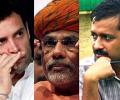
Rahul Gandhi thinks his imaginary Congress is the silver bullet; Narendra Modi thinks he himself is the silver bullet; Arvind Kejriwal seems to think that neighbourhood councils are a silver bullet. But none of them is right, says Mihir S Sharma.

PM Modi seems to be gradually ending India's strategic ambiguity

'Where have we failed, as parents, teachers and leaders, that our children have forgotten all tenets of decent behaviour and respect for women?' President Pranab Mukherjee asks the nation on the eve of Republic Day.
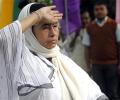
Given her penchant for obfuscating issues Mamata is encouraging the false perception, parroted by her political hangers-on, that all refugees from Bangladesh would face the brunt of deportation once the BJP came to power. In fact, Didi's theatrics and those of all her extras, in the last few days, have been based on propagating this falsehood, says Dr Anirban Ganguly.
